
What is CPM?
CPM stands for Cost Per Mille — "mille" being Latin for one thousand. Simply put, it tells you how much you're paying for every 1,000 impressions your ad receives. It's a useful metric for understanding how impactful your advertising dollars are.
CPM = ($50 ÷ 5,000) × 1,000 = $10 CPM
A $10 CPM means you're paying $10 for every 1,000 times your ad is seen on a billboard — roughly one cent per individual viewer.
What is an impression?
Each time your ad displays on a billboard, people are passing by. An impression is a measurement of how many people are estimated to see your ad each time it plays. These estimates are based on independent traffic data and vary based on the location's traffic patterns and time of day.
Off-peak times — like late nights or early mornings — will generally deliver fewer impressions, but at a lower cost per display. Busier times bring more impressions, and typically a higher cost.
Why CPM matters
The number of people that see your ad can vary. The cost of each individual display can also vary. Looking at just one or the other can be misleading — CPM ties them together into a single, comparable number.
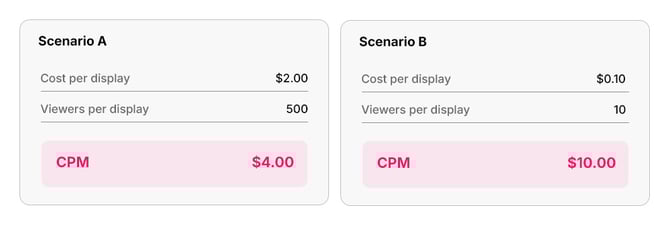
Scenario A costs more per display, but reaches far more people — making it the better value. CPM makes this clear at a glance. It's also a reliable way to compare performance across multiple billboards you're running, or to benchmark Blip against other advertising channels you're using.
What affects your CPM on Blip?
The cost of advertising with Blip can vary based on a few factors:
📍Location
High-traffic areas like city centers or busy intersections attract more viewers per display — and typically carry a higher CPM than lower-traffic locations.
Rush hours and peak commute times deliver more impressions per play. Off-peak hours cost less per display but reach fewer people.
📈 Demand
When more advertisers compete for the same billboard slots in an area, prices rise. CPM reflects the real-time market demand for each screen.